Showing posts with label Fantasy and Science Fiction. Show all posts

Monday, October 18, 2021

Cog

Written by: Greg van Eekhout

Illustrated by: Beatrice Blue

Genre: science fiction

Summary:

Cog looks like an average 12-year-old boy, but he's actually a robot built to learn what it means to be human. He has a small family made of the scientist who created him and his sister robot, Gina and Ada. When unMIND takes him hostage, Cog discovers a more ominous side of humanity. This unique tale shows the difficulty of being an outsider and trying to understand humanity. 

Teacher Evaluation:

Cog is a great adventure filled with danger and humor, making it great for third to sixth-grade students. It would be interesting to integrate some computer science curriculum into the classroom with this text. My students would become "app developers" to create software that focuses on characterization in stories. First, we would discuss what features the author uses to shape each character in this book. Then, students would use a basic app development software to create books where the narrator paints a clear picture of the characters using the features we discussed. 


Thursday, October 14, 2021

Frank Einstein and the BrainTurbo

Written by: Jon Scieszka

Illustrated by: Brian Biggs

Genre: science fiction

Awards: N/A

Summary:

In this book, boy-genius Frank Einstein, his friend Watson and their robot pals Klink and Klank want to help Janegoodall become the starting pitcher for the Midville Mud Hens. The best way to do this would be to strengthen the human body. The group explores all the systems of the human body to find where they could help Janegoodall. Across town, T. Edison is trying to enhance the human body by making a super-powered brain. Of course, he is also trying to over the world.

Teacher Evaluation:

This book would be great for older students in grades four through six. Frank Einstein and the BrainTurbo is about half fiction, half science textbook, allowing teachers to combine the two subjects. In my classroom, students would create short plot summaries that highlight key moments in the story. Then they would create hypotheses about how to improve the human body, build a model of their ideas, then write a short report about why it would or wouldn't work.

Wednesday, October 13, 2021

Harold's Treasure Hunt

Written & Illustrated by: Crockett Johnson

Genre: Fantasy

Awards: 

Summary:

Harold is on a new adventure with his purple crayon; he's exploring life as a pirate, using his imagination to go on a treasure hunt. Harold takes us along for the ride as he spends time on a pirate ship, under the sea, and with a unique array of sea creatures. Once he finds a deserted island, Harold continues his search in a dark cave, where he finds a box of toys, the best treasure of all. 

Teacher Evaluation:

Harold's Treasure Hunt would be best for early education students through second-grade students. Young students can benefit from this book because it demonstrates the importance of art and creativity. I would have these students create their own adventures using what they know from art classes. This book would be great to discuss chronological order for older students. First and second-grade classes could complete a classroom treasure hunt where they have to reconstruct the events of this story.  Students could then create their own treasure hunts where they put the rules of chronological events into practice.


The True Story of the 3 Little Pigs

Written by: Jon Scieszka

Illustrated by: Lane Smith

Genre: Fantasy

Awards: 2009 Notable Children's Recordings

                1991 Black-Eyed Susan Book Award 

                1991 Flicker Tale Children’s Book Award 

Summary:

Here's the story: Alexander T. Wolf, better known as the Big Bad Wolf, is innocent. At least, he believes that he is innocent. In this book, we finally hear the wolf's side of the story. He claims that what we've been told about the Three Little Pigs is all a big misunderstanding. Mr. Wolf says that he had no issue with the pigs; he just wanted to borrow a cup of sugar for his Granny's birthday cake. He also was dealing with a sneezing cold, which was why he kept blowing their houses down. Of course, when the pigs died, he couldn't just leave a good meal there. The wolf lays all these details out for readers to determine if his time in jail is deserved. 

Teacher Evaluation:

I think this book would be best for first-grade through third-grade students. My classes would use this book along with a traditional telling of the Three Little Pigs to complete a compare and contrast unit. We would first construct a general timeline using information collected from each story, then complete a Venn diagram that shows what both tales have in common and where they differ. I would also teach point of view and how it affects the story.

Dragons Love Tacos 2: The Sequel

Written by: Adam Rubin

Illustrated by: Daniel Salmieri

Genre: Fantasy 

Summary:

Oh no! We've run out of tacos! In this sequel, readers see that the Dragon's love for tacos has grown so much that they've depleted their supply. A boy and his dog decide to use a time machine (conveniently placed in the garage) to go back and get enough tacos to plant a taco tree. They run into some trouble, accidentally going to the time the dragons ate spicy tacos, then going too far back to the time of primitive people. The boy and his dog finally get the time machine to the right moment and grab enough tacos to plant a field of taco trees.

Teacher Evaluation:

I would use this book for pre-k through first-grade classrooms. For early learners (pre-k and kindergarten), I would use this book to work on listening skills and some basic reading, like phonetics and letter sounds. This book would be good for teaching first-graders sequencing and plot orders. I would first teach the parts of a plot then we would identify the parts in Dragons Love Tacos 2. I would also use this book to explain the writing process. I would use a taco foldable that shows each part of the process. 


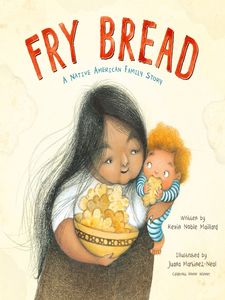
Fry Bread: A Native American Family Story

Written by: Kevin Noble Maillard Illustrated by: Juana Martinez-Neal Genre: poetry, informational Awards:  2020 Robert F. Sibert Information...